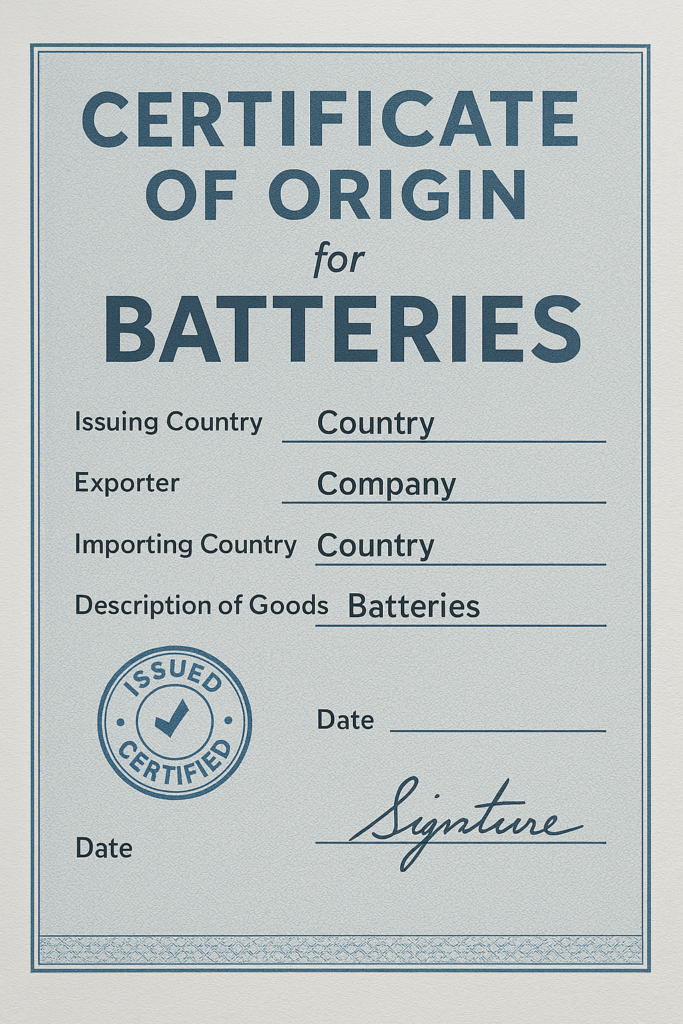
As global trade regulations continue to evolve, many countries have implemented strict import requirements for specific goods, including batteries. One of the key documents required in international trade is the Certificate of Origin (CO), which verifies the country where a product was manufactured. This document is crucial for customs clearance, tariff application, and ensuring compliance with trade agreements. Below, we explore some of the countries that require a CO for battery imports and the rationale behind these regulations.
1. United States
The U.S. enforces stringent import regulations on batteries, particularly lithium-ion and lead-acid types, due to safety and environmental concerns. While a CO is not always mandatory, it may be required under free trade agreements such as the USMCA (United States-Mexico-Canada Agreement) or when dealing with anti-dumping duties. Importers should verify with U.S. Customs and Border Protection (CBP) for specific requirements.
2. European Union
The European Union mandates a CO for battery imports in cases where preferential trade agreements are applicable, such as when importing from countries with which the EU has signed trade deals. Additionally, compliance with the EU Battery Regulation and REACH (Registration, Evaluation, Authorisation, and Restriction of Chemicals) is crucial for importers.
3. China
China has stringent regulations on battery imports, particularly regarding hazardous materials. A CO is often required to determine the origin of the batteries and ensure compliance with local safety standards. Additionally, China’s import policies may vary depending on the trade agreements in place with the exporting country.
4. India
India imposes strict import regulations on batteries to ensure product quality and safety. A CO is commonly required, especially when availing of preferential tariffs under trade agreements. Additionally, compliance with the Bureau of Indian Standards (BIS) certification is essential for battery imports.
5. Canada
Canada may require a CO for battery imports under specific trade agreements, such as the USMCA. Furthermore, certain types of batteries, particularly lithium-ion batteries, are subject to additional safety certifications and compliance requirements by Transport Canada and other regulatory bodies.
6. Australia
Australia often requires a CO for battery imports to determine eligibility for preferential trade tariffs. The Australian Border Force enforces strict import conditions, especially for batteries containing hazardous substances, ensuring compliance with national safety and environmental standards.
7. Brazil
Brazil mandates a CO for battery imports, especially under its various trade agreements. The country also imposes strict environmental and safety regulations on batteries, necessitating compliance with the National Institute of Metrology, Standardization, and Industrial Quality (INMETRO) certifications.
Why is a Certificate of Origin Important?
The CO serves multiple purposes in international trade:
Tariff and Duty Benefits: Certain trade agreements provide reduced tariffs or duty-free access based on the CO.
Regulatory Compliance: Countries enforce different safety and environmental standards that may require proof of origin.
Anti-Dumping and Counterfeit Protection: The CO helps prevent the importation of counterfeit or substandard batteries by verifying authenticity and compliance.
Conclusion
Understanding the import requirements for batteries, including the necessity of a Certificate of Origin, is crucial for businesses engaged in global trade. Regulations vary by country, and staying informed about specific requirements can facilitate smoother customs clearance and ensure compliance with international trade laws. Importers should always check with local customs authorities or trade regulatory agencies to confirm the latest requirements before shipping batteries across borders.