🔋 Application: Emergency Lighting Systems
Nickel-Cadmium (Ni-Cd) batteries are a proven solution for emergency lighting, offering stable performance, long life, and excellent tolerance to high and low temperatures. This brochure highlights their capabilities in cold environments, where reliable discharge is critical during power outages.
🌡️ Low Temperature Discharge Performance
When used in emergency lighting, Ni-Cd batteries are expected to discharge power during outages—even under freezing conditions.
| Battery Type | Discharge Temp. Limit | Relative Capacity at -20°C |
|---|---|---|
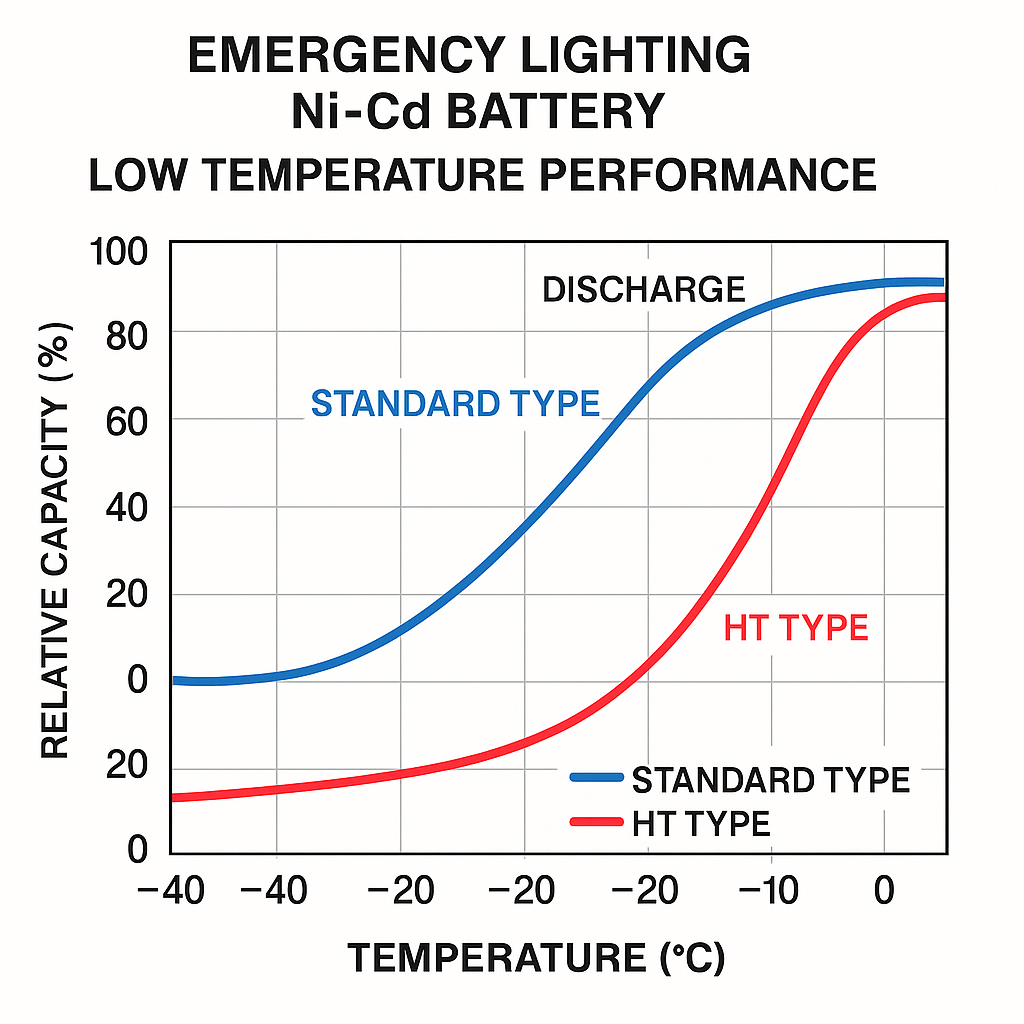
| Standard Ni-Cd | -20°C (min. -30°C) | Approx. 50–60% |
| HT (High Temp) Ni-Cd | -30°C | Approx. 40–50% |
- Standard types support discharge to -20°C.
- HT-type batteries provide improved performance in both low and high temperature environments.
✅ Ideal for underground tunnels, stairwells, cold warehouses, and unheated areas.
⚠️ Charging Recommendations
| Charging Temp Range | Risk Below 0°C |
|---|---|
| 0°C ~ +40°C | Risk of gas buildup, shortened life |
- Charging below 0°C is not recommended for most Ni-Cd batteries.
- For colder climates, use insulated housings or temperature-controlled enclosures.
🧊 Storage and Environmental Guidelines
| Parameter | Range |
|---|---|
| Storage Temp | -20°C to +30°C (short-term: -40°C) |
| Operating Temp | -20°C to +40°C (discharge) |
| Charging Temp | 0°C to +40°C |
📊 Performance Comparison Chart
A graphical comparison of discharge capacity at low temperatures between standard and HT-type Ni-Cd batteries.
✅ Conclusion & Recommendations
- Choose HT Ni-Cd batteries for locations with harsh temperature variations.
- Ensure batteries are not charged below 0°C unless supported by design.
- For extremely cold environments, consider alternative chemistries such as LiFePO₄ with thermal management.